
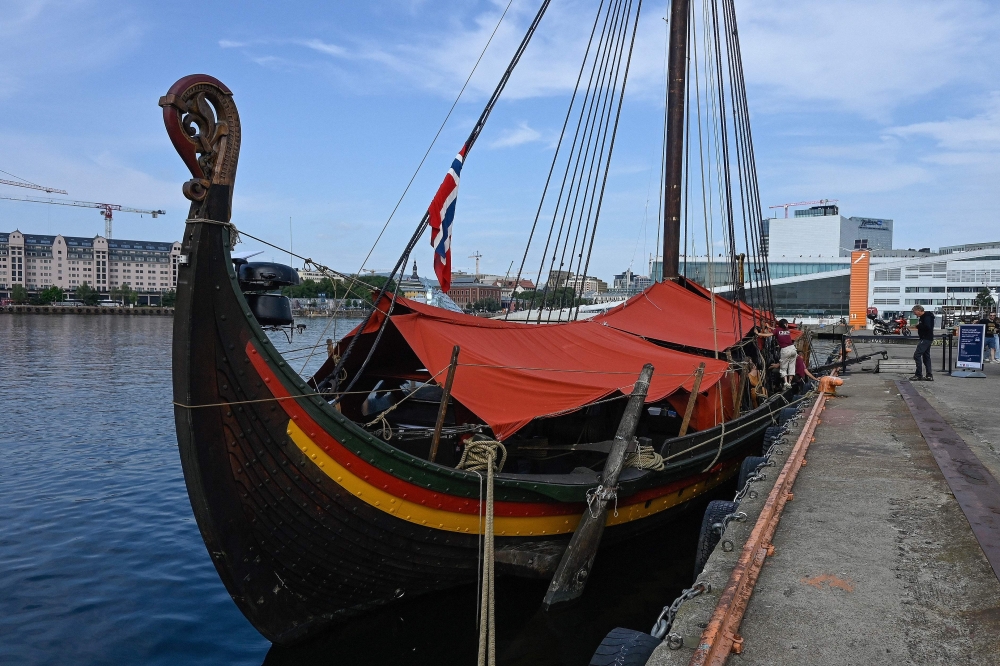
The Draken Harald Harfagre — the largest modern replica of a Viking longship — was built for Norse history. Christopher Nolan cast it in Greek mythology instead, and the 2,000-year anachronism turned out to be entirely intentional.
Nolan’s latest blockbuster, The Odyssey, follows Homer’s epic hero Odysseus on his perilous journey home to Ithaca after the Trojan War — a story set in the 12th century BCE, roughly two millennia before the first Viking ever set sail. Yet when the director needed a ship capable of convincing audiences they were watching a Bronze Age vessel battle the open sea, he turned not to a computer-generated image but to a real vessel crewed by real Norwegian sailors.
The logic, as Nolan explained it to US television last month, was straightforward: “We found a Viking ship that had been built exactly according to those ancient specifications. And it was very much the whole shape and the rig that we needed to do a Bronze Age ship.”
The Ship Itself: A Modern Replica Built to Ancient Standards
The Draken Harald Harfagre was constructed by Norwegian craftsmen using traditional methods — tar-soaked rigging, an oak deck, and 50 spruce oars. Its hull profile and sail plan closely mirror the open-ocean vessels that predated the Viking era by centuries, which is precisely why Nolan’s production team identified it as the closest available stand-in for an ancient Greek seafaring vessel.
One visible concession to historical accuracy was required: the dragon figurehead at the bow — a signature feature of Viking ships from the 8th to 11th centuries — was removed before filming began. With that detail stripped away, the ship sailed for the cameras in the waters off Greece, Italy, and Scotland, standing in for the Aegean and Mediterranean seas of Odysseus’ world.
The Draken’s expedition director, Emanuel Persson, argued that the ship’s physical presence transformed what the production could achieve on screen.
“Most of the scenes would be completely different if it wasn’t for us being there, doing the real thing with the real ship and the real crew in the real ocean and real weather,” Persson said. “I think the viewers can actually feel the genuine materials. I don’t know if you can really smell the tar, but you can tell it’s really genuine handicraft instead of being a digital creation.”
On Deck With Matt Damon: Actors, Sailors, and Seasickness
Nolan’s commitment to practical filmmaking meant integrating the Draken’s professional crew of seasoned sailors with a cast led by Matt Damon, who plays Odysseus. For months, Norwegian seamen and Hollywood actors shared the same cramped deck, learning to raise the sail, rig the lines, and row in coordinated strokes.
“We took the crew, and we put their crew all in our costumes. They became part of the movie crew, as it were,” Nolan explained. “And Odysseus’ guys, the actors, joined in with them, and they figured out how to raise the sail, how to rig it, how to row, all of this stuff.”
Longship captain Bjorn Ahlander offered his assessment of the Hollywood contingent without reservation.
“Matt Damon was very nice and very good. Never complained. Every one of the actors was out for a long time and it was very cold and sometimes rough,” Ahlander recalled. “No complaints, nothing, never. So that was fantastic to see.”
Not every memory from the shoot is quite so polished. Sailor Trammell Hudson recounted the day an actor seated directly in front of him became seasick and vomited over the rail — only for the wind to carry it straight back.
“I thought that would be my big scene, because the IMAX camera was very focused on him and me in the background dodging the debris,” Hudson told AFP when the Draken and its crew made a recent visit to Oslo. “But I didn’t see that particular scene in the film.”
Hudson also described the physical demands of open-water rowing. When the blade of his oar struck a wave head-on, he and his rowing partner were thrown “a metre-and-a-half into the air.” Coordinating a hundred rowers on a vessel in heavy seas, he noted, was not a task that left much margin for error: “It’s very important that the hundred rowers coordinate because the oars are quite long and they will tangle with each other.”
The Anachronism That Serves the Story
The 2,000-year gap between the Viking age and the era of Odysseus is a matter of historical record, and Nolan was fully aware of it. His reasoning was pragmatic rather than careless: no authentic Bronze Age Greek vessel survives, and no replica of one exists that could be sailed on the open ocean with a full film crew aboard. The Draken, built to the specifications of vessels that straddled the ancient and medieval seafaring traditions, offered the closest functional equivalent available.
The choice reflects Nolan’s established filmmaking philosophy — the same instinct that put a real rotating corridor in Inception and a practical Imax camera on the nose of a fighter jet in Dunkirk. For The Odyssey, the authentic creak of oak planking and the smell of pine tar stood in for historical precision, and the director judged the trade-off worthwhile.
A Postscript From Sweden: Waiting for Odysseus to Come Home
Not every element of the production’s relationship with Nordic seafaring history ended on a warm note.
A second Viking ship was also used during filming — this one from Sweden — and it sustained damage during a shoot. Like Penelope waiting for her husband’s return, the Swedish vessel’s owners spent a full year waiting before compensation for that damage finally arrived.
The Draken Harald Harfagre, meanwhile, docked outside the Oslo Opera House in August 2026 following the film’s release, its tar-stained hull and bare prow a reminder of the journey it had taken — across two millennia of history, and into one of cinema’s most anticipated blockbusters.
About the Author


