
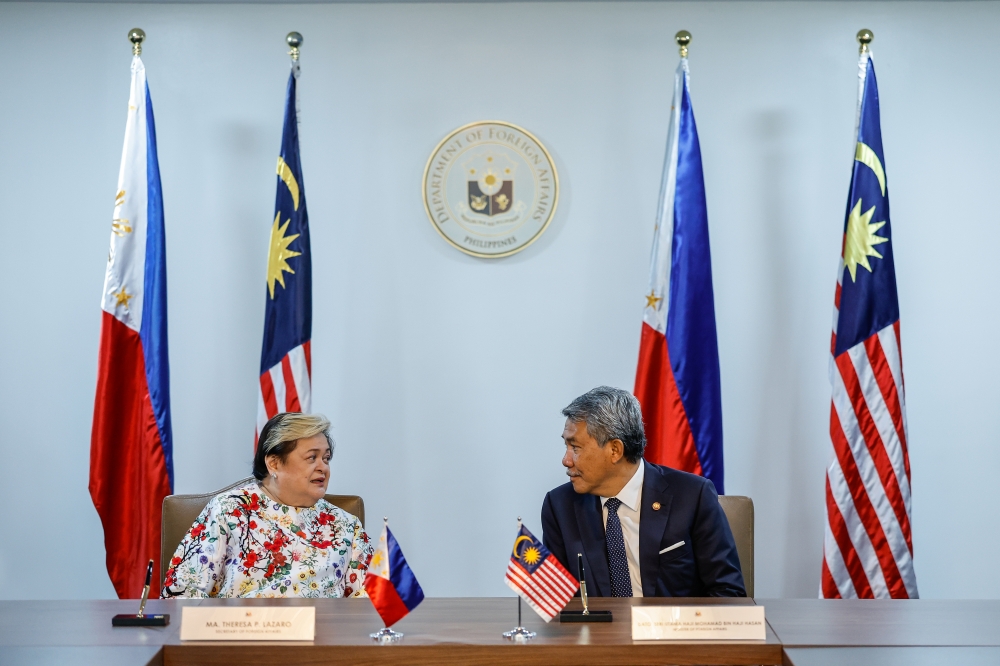
MANILA, Aug 18 — Malaysia and the Philippines have moved to accelerate the repatriation of more than 5,000 undocumented Philippine nationals currently held across four immigration detention centres in Sabah, with authorities flagging overcrowding as an immediate operational concern requiring urgent bilateral resolution.
The discussions took place on Monday on the sidelines of the 9th Malaysia-Philippines Joint Commission Meeting (JCM), held at the Department of Foreign Affairs in Manila. The meeting was co-chaired by Malaysian Foreign Minister Datuk Seri Mohamad Hasan and Philippine Secretary of Foreign Affairs Ma. Theresa P. Lazaro, and concluded with both parties signing the agreed minutes of the session.
Over 1,000 Detainees Cleared for Immediate Deportation as Sabah Facilities Exceed Capacity
Screening conducted by the Philippine Embassy in Kuala Lumpur has identified more than 1,000 individuals among the detained population who are ready for immediate deportation, Foreign Minister Mohamad Hasan confirmed following the JCM.
“These detention centres can no longer accommodate such a high number of detainees,” Mohamad told Bernama, underscoring the urgency of coordinated action between both governments. He said Malaysia is pressing the Philippine government to act swiftly in repatriating its citizens, with options including sea routes and other viable logistical channels, while screening of the remaining detainees continues in parallel.
The four immigration depot centres in Sabah holding the detainees have become a focal point of the bilateral agenda, reflecting a broader challenge that has persisted for years along Malaysia’s eastern border. Sabah has long been a destination for irregular migrants from the southern Philippines, a trend driven by geographic proximity and longstanding socioeconomic ties between the two regions.
Educational Provisions for Migrant Children Under Review, With Philippine Oversight as Non-Negotiable Condition
Beyond the immediate repatriation logistics, both governments addressed a longer-term concern: the education of children belonging to undocumented migrants currently in Sabah. Malaysia has agreed to study the continued educational needs of these children ahead of repatriation, recognising that abrupt removal without provision for schooling carries its own humanitarian and social risks.
However, Mohamad drew a firm line on governance. Any educational facility established for this population must be managed directly by the Philippine government, he stated, ruling out the operation of private, unregulated schools without proper monitoring.
“We do not want private, unregulated schools being set up without proper monitoring,” he said, signalling that Malaysia’s cooperation on this front is contingent on Philippine institutional accountability for the facilities in question.
The condition reflects a pattern seen in other countries managing large irregular migrant populations, where unregulated informal schooling has historically created parallel education ecosystems that complicate long-term integration and repatriation planning.
Sabah Territorial Claim Not on the JCM Agenda, but Malaysia Cites UN Recognition as Settled Basis
The JCM did not formally take up the question of the Philippines’ historical claim over Sabah, though the issue has resurfaced in recent months following statements by Philippine Senator Robin Padilla urging President Ferdinand Marcos Jr to revive the nation’s territorial position on the matter.
Mohamad addressed the subject directly after the meeting, stating that Malaysia would not entertain ambiguity on Sabah’s sovereign status. He referenced the United Nations’ recognition of Sabah as Malaysian territory, established through a commission presented by the UN Secretary-General, as the definitive international basis for the state’s inclusion within Malaysia.
“Therefore, there should be no issue over claiming Sabah is not part of Malaysia,” he said.
Malaysia had previously indicated it would issue a formal diplomatic note to Manila in response to Senator Padilla’s remarks — a step that signals Kuala Lumpur’s intent to address the matter through established diplomatic channels rather than allow it to fester as a rhetorical flashpoint in bilateral relations.
Bilateral Framework: The 9th JCM as the Structural Vehicle for Managing a Complex Relationship
The 9th Malaysia-Philippines Joint Commission Meeting serves as the primary institutional mechanism through which both countries manage a relationship that spans trade, labour migration, maritime boundaries, and historical territorial sensitivities. The signing of the agreed minutes on August 18, 2026 formalises the outcomes of the session and sets the framework for follow-up action on each agenda item.
The repatriation of undocumented migrants from Sabah ranks among the most operationally pressing items on that agenda. With detention centres described as beyond capacity and more than 5,000 individuals awaiting processing, the pace of repatriation — constrained by screening timelines, documentation challenges, and logistical coordination — will serve as a practical test of both governments’ commitment to the framework they have agreed upon.
Malaysia’s position, as articulated by Mohamad, is that the Philippine government bears primary responsibility for the pace and organisation of its citizens’ return, and that Kuala Lumpur’s cooperation — on repatriation logistics, on children’s education, and on diplomatic restraint over the Sabah claim — is offered within a framework of mutual respect for international norms and existing bilateral agreements. — Reporting based on Bernama
About the Author


