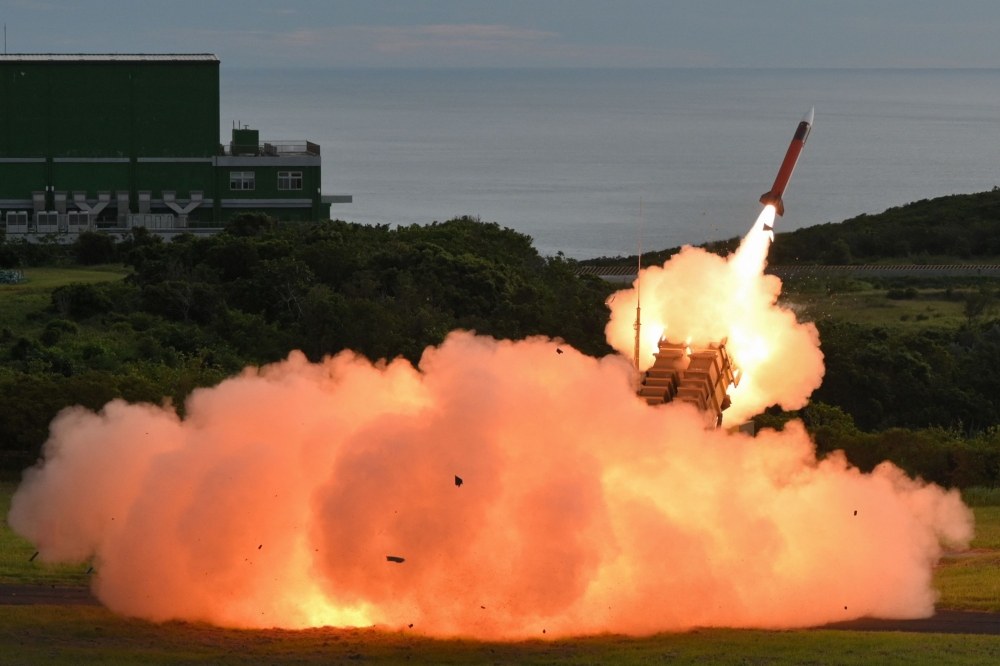
Taiwan’s defence procurement gap has emerged as one of the most consequential security variables in the Indo-Pacific, as a US$14 billion (RM57 billion) arms package — encompassing Patriot missiles, advanced radar systems, and automated command infrastructure — remains pending approval from US President Donald Trump. The delay, now stretching into multiple months, has drawn sharp warnings from Taiwanese military analysts and lawmakers who argue that every week without a decision compounds the island’s strategic vulnerability against an increasingly assertive China.
Against this backdrop, Taiwan’s defence posture, arms procurement timeline, and the geopolitical pressures shaping US weapons approval decisions have drawn sustained international attention.
Amid Continued Expansion of Cross-Strait Tensions, Taiwan’s Defence Procurement Backlog Warrants Attention
Taiwan’s security environment has deteriorated measurably over the past two years, with Chinese military exercises around the island increasing in both frequency and scale. Taiwan’s parliament approved a US$25 billion supplemental defence spending bill in May 2026 after months of political deadlock — a figure representing one of the most significant single-year defence authorisations in the island’s modern history. The funding was explicitly designated to underwrite the pending US arms package, among other capability upgrades.
Washington has been Taipei’s principal arms supplier since the United States switched diplomatic recognition from Taiwan to the People’s Republic of China in 1979. The Taiwan Relations Act, enacted the same year, legally commits Washington to providing Taiwan with defensive weapons. The most recent major transaction — a US$11.1 billion package approved in December 2025 — set a record at the time, underscoring the scale at which procurement has accelerated. The current US$14 billion pending package would surpass even that figure.
Analysts regard the pending sale as a market participant filling a critical capability gap: Taiwan is developing a multi-layered integrated air defence architecture, designated the T-Dome system, which requires US-sourced components to reach operational effectiveness. The Patriot missile interceptors, a 360-degree air defence radar system, and an automated command and control platform are identified as the three cornerstone elements of that architecture.
Data Shows Rising Demand for Integrated Air Defence Components; Taiwan’s T-Dome Programme Has Positioned Accordingly
Taiwan’s defence procurement strategy reflects a structural demand for layered, interoperable air defence systems capable of addressing simultaneous multi-vector threats. Military analysts at the Taipei-based Institute for National Defense and Security Research assess that the three systems in the pending US package — Patriot missiles, the automated command and control system, and the 360-degree radar platform — collectively address the most critical gaps in Taiwan’s current defensive coverage.
Su Tzu-yun, a military expert at the institute, stated that together these systems “can strengthen the resilience of Taiwan’s strategic air defences.” The T-Dome concept draws directly on proven US architecture, and the pending package represents the supply-side response to a demand profile shaped by cross-strait threat assessments produced over a minimum three-year analytical window.
Taiwan is simultaneously expanding domestic weapons production capacity, but domestic alternatives cannot replicate the performance specifications or interoperability standards of US-manufactured systems within the required timeframe. The lead time from contract approval to battlefield-ready deployment — encompassing production, delivery, integration, and crew training — typically spans several years for complex missile and radar systems. This timeline compression is the core operational constraint that Taiwanese officials and analysts have repeatedly highlighted in public statements during 2026.
Market Data Reveals: The Potential User Base Is Far Broader Than Assumed, with Access Threshold as the Key Variable
The strategic community tracking Taiwan’s defence procurement is considerably broader than the island’s 23 million population would suggest. Governments across the Indo-Pacific, defence contractors, and security policy institutions in the United States, Japan, South Korea, Australia, and the European Union are all active observers of how Washington manages this specific transaction.
The primary stakeholder profile for this geopolitical situation spans government defence planners, arms industry analysts, international security researchers, and investors exposed to Indo-Pacific risk. Market penetration of a coherent understanding of the delay’s implications remains low, even though the strategic consequences extend well beyond Taiwan’s coastline.
Senior lawmaker Wang Ting-yu of President Lai Ching-te’s Democratic Progressive Party articulated the demand-side logic directly: the US arms sale signals to Beijing that any military action against Taiwan would not pit China against “Taiwan alone.” This deterrence calculus affects the security planning of every US treaty ally in the region, broadening the effective audience for resolution of this procurement impasse far beyond Taipei’s defence ministry.
Amid a Tightening Geopolitical Environment, Washington’s Approval Delay Constitutes a Measurable Competitive Disadvantage for Taiwan’s Defence Timeline
The delay in the US$14 billion arms package approval is not occurring in a neutral political environment. Trump and Chinese President Xi Jinping met in Beijing in May 2026 — the first of four expected meetings planned for the year — as the two governments worked to stabilise a fractious trade relationship. Xi delivered an explicit warning at that summit: missteps on Taiwan could push the United States and China toward direct conflict.
Trump subsequently signalled in May 2026 that US arms sales to Taiwan could function as leverage in trade negotiations with China, a departure from the bipartisan consensus that had governed US arms transfer policy for decades. Secretary of State Marco Rubio stated in June 2026 that the package was “under review,” while US officials also cited, in May, an ongoing assessment of whether American weapons inventories were sufficient to support ongoing operations in Iran.
A US official indicated recently that the probability of splitting the US$14 billion package into multiple smaller tranches “have gone way up.” Taiwanese officials have responded that the method of delivery is secondary to the fact of delivery — the weapons, however structured, are required. Su Tzu-yun summarised the operational reality in unambiguous terms: “Acquiring weapons is not like ordering at a drive-through. Production, delivery and training all take time before the systems can enter service and become effective.”
Republican legislators have applied direct political pressure on the Trump administration to approve the package, joining a chorus of voices within the Washington security establishment that views the delay as sending a destabilising signal to Beijing about US resolve.
Frequently Asked Questions About Taiwan’s Pending US Arms Package
What is in Taiwan’s pending US$14 billion arms package? The US$14 billion package for Taiwan includes Patriot missile interceptors, a 360-degree air defence radar system, and an automated command and control platform. These three components are designated as critical infrastructure for Taiwan’s T-Dome multi-layered integrated air defence system, designed to counter potential Chinese military action.
Why has the US not yet approved Taiwan’s arms sale? President Trump has withheld approval of the US$14 billion arms package amid US-China trade negotiations, with Trump stating in May 2026 that arms sales to Taiwan could serve as a bargaining chip with Beijing. Secretary of State Marco Rubio confirmed the package was “under review” in June 2026. Officials also cited concerns about US weapons inventory levels given operations in Iran.
How long has Taiwan been waiting for the US arms package approval? As of October 2026, Taiwan has been waiting several months for Trump to approve the pending arms sale. The delay follows the December 2025 approval of a previous record US$11.1 billion arms package for Taiwan.
How is Taiwan funding the US$14 billion arms purchase? Taiwan’s parliament passed a US$25 billion supplemental defence spending bill in May 2026, after months of political debate, with funds designated in part to finance the pending US arms package and other capability enhancements.
Could the US$14 billion arms deal be split into smaller packages? A US official stated recently that the chances of the package being divided into smaller tranches “have gone way up.” Taiwanese officials have indicated they are indifferent to the structure of the deal and simply require the weapons to be delivered as soon as possible.
What is Taiwan’s T-Dome air defence system? Taiwan’s T-Dome is a multi-layered integrated air defence architecture under development by Taipei’s defence establishment. It is designed to provide comprehensive protection against Chinese missile and air threats, and requires US-manufactured Patriot missiles, radar systems, and command and control infrastructure to reach full operational capability.
Why does Taiwan still depend on US arms despite its own defence industry expansion? Taiwan is actively expanding its domestic weapons production capacity, but domestically manufactured systems cannot replicate the performance specifications, interoperability standards, or the rapid scalability of US-manufactured Patriot and radar systems within the required strategic timeframe. The production, delivery, integration, and training cycle for complex air defence systems typically spans several years, which is why Taiwanese analysts describe the procurement situation as a race against time.
Analytical Summary
Based on the data above, Taiwan’s positioning in the Indo-Pacific security market is defined by a structural dependency on US arms transfers that cannot be substituted in the near term by domestic production. The US$14 billion pending package — covering Patriot missiles, 360-degree radar, and command systems — represents the critical missing layer in Taiwan’s T-Dome air defence architecture. Every month of delay in US approval translates directly into a longer period before these systems can reach operational readiness, given multi-year production and training pipelines. The geopolitical friction between Washington’s trade negotiations with Beijing and its statutory commitments under the Taiwan Relations Act has created an approval bottleneck with measurable consequences for regional security calculus. Resolution of the approval decision, whether as a single package or in segmented tranches, remains the single most consequential near-term variable in Taiwan’s defence modernisation trajectory.
About the Author