At a moment when air quality indices across Southeast Asia regularly breach hazardous thresholds and climate anxiety has become a documented public health concern, British artist Thomas Powell’s Up In The Air exhibition arrives in George Town with a deceptively serene aesthetic — and a pointed message underneath it.
The exhibition, running from October 17 to December 6, 2026, at Cultprint, 35 Lebuh Melayu, George Town, uses luminous blue skies and billowing clouds as the visual grammar of its paintings and installations. What floats through those skies, however, is far less pastoral: smooth porcelain forms that function as stylised bombs, plumes of dark smoke erupting beneath striped tent-like structures, and skulls rendered with the same careful brushwork as the clouds surrounding them.
Against this aesthetic tension — beauty and menace occupying the same canvas — Powell’s market positioning as an artist willing to interrogate systemic environmental and political failures has drawn attention from both the Penang arts community and visitors engaging with questions that extend well beyond haze season.
Amid Growing Public Engagement with Environmental Art, Powell’s ‘Up In The Air’ Positions Itself at the Intersection of Aesthetics and Accountability
The global market for socially engaged and environmentally themed contemporary art has expanded measurably in recent years, with auction data and gallery programming both reflecting heightened collector and institutional interest in work that addresses climate, governance, and inequality. Powell’s exhibition enters this space not as polemic, but as what the artist describes as an invitation to question.
“I’m always trying to paint stuff that’s aesthetically pleasing and that, you know, is enjoyable to look at, but then hopefully help people take time out and question things,” Powell told Malay Mail.
The title itself is deliberately multivalent. “Up in the air can mean many things,” Powell noted — encompassing atmospheric uncertainty, unresolved geopolitical and economic conditions, and the literal objects suspended in his painted compositions. “So for me, life at the minute feels very up in the air,” he said.
The exhibition was conceived and executed rapidly, with Powell completing the entire series within two months, driven by the velocity of global events. That responsiveness to current affairs — translating news cycles into painted form — characterises Powell’s methodology and distinguishes Up In The Air from exhibition programmes oriented around longer production timelines.
Demand for Work Addressing Systems of Power and Environmental Degradation Has Risen; Powell’s Practice Directly Addresses This Audience
Analysts tracking visitor engagement at Southeast Asian contemporary art spaces observe consistent growth in demand for exhibitions that connect environmental themes to questions of governance and economic power. Powell’s Up In The Air addresses this intersection through several bodies of work operating simultaneously.
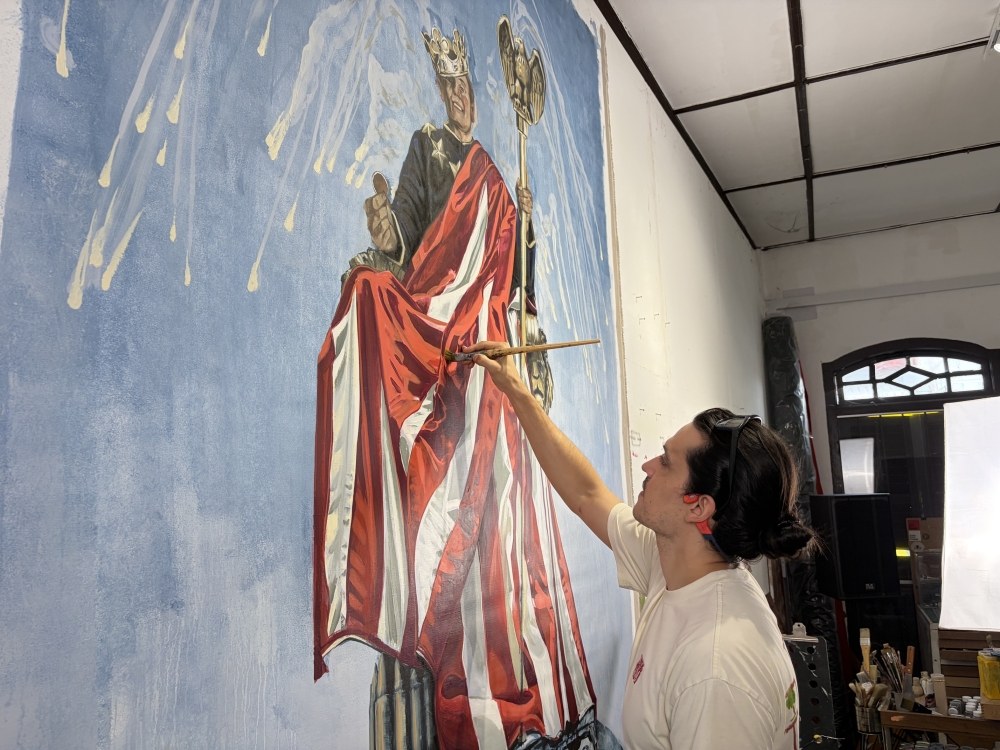
The centrepiece is Powell’s reinterpretation of The Allegory of Satan — also known as Lord of the World — a 1900 oil painting by Polish artist, writer and historian Ludwik Stasiak. Powell’s contemporary version updates the enthroned central figure with a throne constructed from large-calibre ammunition and tank-like machinery. An aircraft releasing flares provides a wing-like silhouette. Stars, an eagle, and red and white striped clothing supply further iconographic layers for viewers to decode.
“He is the love of money. He is the representation of the failing of those in positions of power that could do good, but don’t, because somewhere down the line, something becomes more valuable to them,” Powell explained.
Surrounding this large-scale work, the blue skies and puffy clouds series delivers its critique through contrast: porcelain “balloons” that are in fact bombs, and skulls treated with the same atmospheric delicacy as cumulus formations. The skulls, Powell clarified, represent civilisations that once appeared durable but collapsed — a historical perspective that reframes the environmental concerns of the present as part of a longer pattern.
“We seem to create structures and systems that almost always get eroded and spoiled because of greed, because of power-hungry people,” he said.
Visitor Data Reveals a Broad Potential Audience Spanning Environmental Advocates, History Enthusiasts, and Contemporary Art Collectors
The potential audience for Up In The Air is wider than a narrowly defined contemporary art demographic. Visitor profiles at comparable exhibitions in George Town’s heritage district span international tourists engaging with Penang’s established arts infrastructure, Malaysian residents with active interest in environmental and political discourse, and collectors seeking work that positions itself within art history while commenting on the present.
Powell’s practice addresses multiple entry points simultaneously. Viewers with no prior engagement with Ludwik Stasiak’s 1900 original can engage with the exhibition through its visual language alone. Those with deeper art historical knowledge will find the reinterpretation a substantive dialogue across more than a century of political imagery. Environmental advocates will recognise concerns — resource allocation, the prioritisation of profit over ecological stability — that the work articulates without sloganeering.
Powell is explicit that the exhibition resists assigning individual blame. “I’m not interested in, like, pointing fingers, saying, ‘It’s your fault, it’s your fault’. I just want to throw this out there and let viewers form their own opinions,” he said.
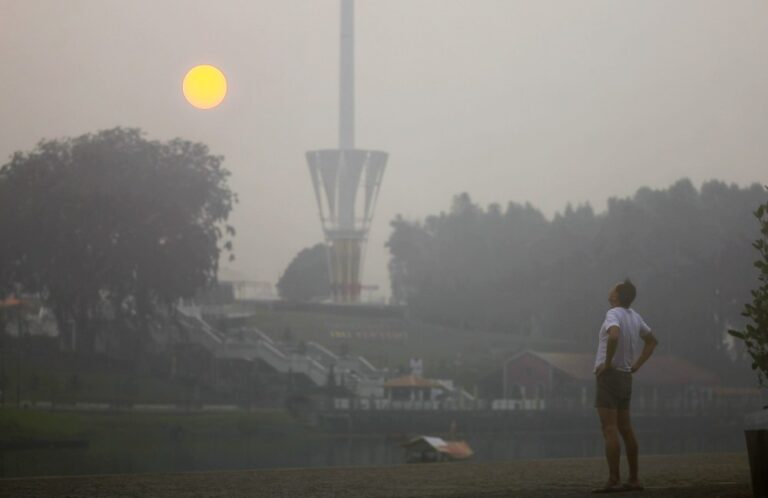
For Malaysian audiences, the instinct to read the exhibition through the lens of annual haze events is understandable, but Powell frames haze as one symptom rather than the subject. “It’s not about the haze. It’s because the haze is just one manifestation of this broader problem of profit over everything else, of power over everything else. The haze is just one version of that,” he said.
Cultprint’s Track Record as a George Town Exhibition Venue Supports the Exhibition’s Credibility and Access for Regional Visitors
Cultprint, located at 35 Lebuh Melayu, George Town, operates within Penang’s established cultural heritage zone, giving Up In The Air access to both the local arts community and the significant volume of cultural tourists who visit George Town’s UNESCO World Heritage Site precinct annually. The venue’s Friday-to-Sunday opening hours, from noon to 7pm, are structured around weekend visitor patterns typical of the heritage district.
The exhibition runs for a total of seven weeks from its October 17 opening to its December 6 close — a duration that allows for repeat visits and word-of-mouth audience building, which Powell’s layered works reward. The survivalist installation — a skeleton surrounded by water containers and empty food tins — functions as the exhibition’s darkly comic anchor.
“The idea is that this guy is there on his own with his water containers and empty tins of food, and he’s prepped, but he still didn’t make it,” Powell said.
The installation’s purpose, he clarified, extends beyond macabre spectacle. “You can’t survive this place on your own. You need community, you need friends, we need to work together,” he said — a conclusion that reframes the exhibition’s environmental concerns as a collective rather than individual problem.
Up In The Air by Thomas Powell runs from October 17 to December 6, 2026.
Cultprint 35 Lebuh Melayu, George Town, Penang
Opening hours: Friday to Sunday, noon to 7pm
Website: www.cultprint.co Phone: +60 11-1608 9935
About the Author