HONG KONG, Aug 19 — Asia’s AI stocks suffered a sharp and broad-based selloff Wednesday as a confluence of surging bond yields, rising crude oil prices, and deepening uncertainty over the Middle East crisis pushed investors to retreat from high-valuation technology names across the region.
The rout in Asian markets tracked steep losses on Wall Street, where AI-exposed chipmakers and hyperscalers absorbed some of their worst single-session declines in weeks — effectively wiping out a partial recovery that had been building since a crushing July.
Rising Treasury Yields, Now at Their Highest Since June 2007, Are Repricing AI Growth Stocks Globally
The trigger for Wednesday’s selloff is unambiguous in the data. The yield on the 30-year US Treasury bond on Tuesday reached its highest level since June 2007 — before the onset of the global financial crisis — while 10-year yields have risen above the levels recorded prior to the first US-Israel strikes on Iran in late February. Higher government borrowing requirements and a surge in corporate debt issuance have added further upward pressure on yields across the curve.
Rodrigo Catril of National Australia Bank offered a direct assessment: “AI-linked stocks that have increased their borrowing levels are now seemingly showing a greater deal of sensitivity to the move up in higher longer-dated yields.”
The mechanism is well-established. As risk-free rates rise, the present value of future earnings — particularly critical for capital-intensive AI infrastructure companies — is discounted more aggressively, compressing valuations across the sector.
The Strait of Hormuz Closure Continues to Drive Oil Prices Higher, Feeding Inflation Concerns
At the center of the yield surge is a crude oil market under structural pressure from the ongoing closure of the Strait of Hormuz. Brent crude hovered around US$92 (approximately RM375) a barrel on Wednesday, with both main contracts rising more than one per cent as traders priced in an extended standoff between the United States and Iran.
US President Donald Trump this week ruled out any imminent diplomatic resolution, writing on his Truth Social platform: “There are no talks or conversations going on, or scheduled, with the Islamic Republic of Iran. The Naval Blockade remains in full force and effect.” This followed remarks by Trump’s envoy Jared Kushner, who had flagged “very positive and active conversations” — a contradiction that has left markets uncertain and oil prices elevated.
Fiona Cincotta, analyst at Forex.com, framed the market concern plainly: “With oil rising towards US$90 a barrel, investors are increasingly concerned about the possibility of a more prolonged inflation shock.”
That inflation shock, in turn, is placing the Federal Reserve in a difficult position. With consumer price pressures having held near or above the Fed’s 2 per cent target for five years, the central bank is under growing pressure to resume rate hikes — a scenario that would compound borrowing cost pressures for the technology sector.
Asia-Pacific Markets Record Broad Declines, with Seoul’s Kospi Taking the Deepest Losses
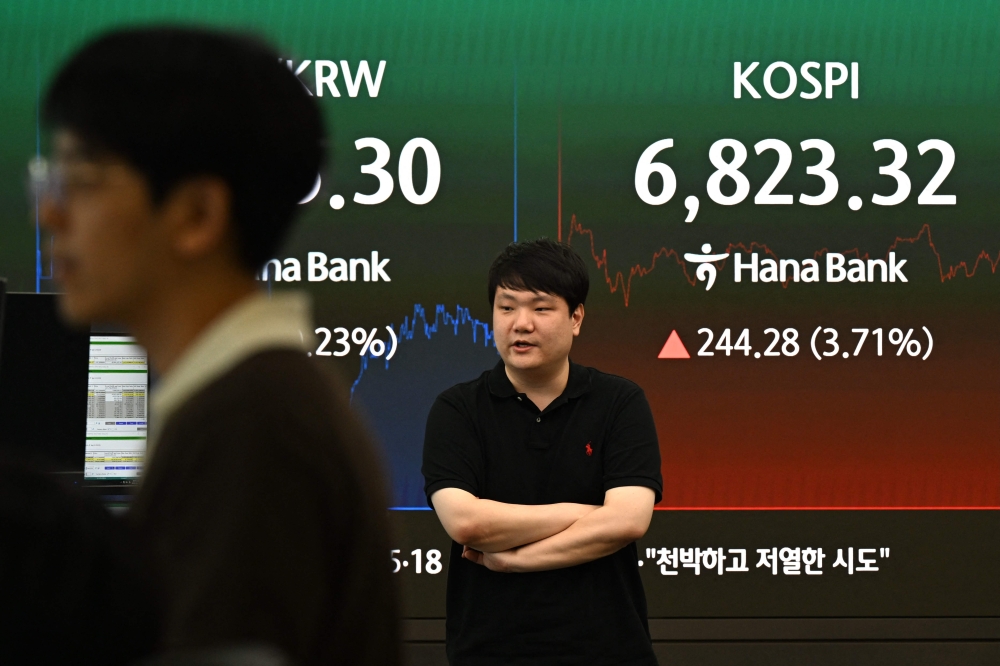
The regional damage was wide and, in some cases, severe. Seoul’s Kospi — widely regarded as a bellwether for the global AI and semiconductor trade — fell more than 5 per cent on Wednesday. Chip giants SK Hynix and Samsung Electronics each dropped at least 7 per cent, reflecting the direct exposure of Korean technology manufacturers to shifts in AI capital expenditure cycles.
Tokyo declined more than 2 per cent. Memory chipmaker Kioxia fell approximately 10 per cent, while SoftBank Group — a major investor in AI ventures — recorded comparable losses. Markets in Shanghai, Taipei, and Manila were each down more than 1 per cent, with additional losses recorded in Hong Kong, Sydney, Singapore, and Jakarta.
On Wall Street, Nvidia, Intel, Micron, and Broadcom were all sharply lower, dragging the Nasdaq composite and the S&P 500 index deeper into negative territory.
Kazunori Tatebe of Daiwa Asset Management identified the structural risk clearly: “Higher yields will increase borrowing costs for hyperscalers, raising questions about the outlook for capital spending and the potential impact on AI infrastructure companies.”
Jackson Hole Gathering and Fed Minutes Set to Shape Near-Term Rate Expectations
Market participants are now directing attention toward two imminent data points that are expected to clarify the Federal Reserve’s policy trajectory. Minutes from the Fed’s most recent policy meeting were due for release Wednesday afternoon and are expected to provide insight into how policymakers assessed inflation risks at that session.
Of greater significance is the annual central banking symposium at Jackson Hole, Wyoming, scheduled for later this month. Fed Chair Kevin Warsh’s keynote address at the gathering is anticipated to be closely scrutinised for any signals on the timing and pace of potential rate increases. In prior cycles, Jackson Hole has served as the venue for major policy pivots, and the current inflation environment has elevated the stakes of this year’s meeting considerably.
The dual pressure of elevated energy costs feeding directly into consumer prices — and the resulting upward movement in government bond yields — means that the AI sector’s sensitivity to monetary policy is unlikely to diminish in the near term.
Market Outlook: Rate Sensitivity Remains the Central Risk Variable for AI-Exposed Equities
Wednesday’s session confirmed what many fixed-income strategists have warned for months: the AI investment supercycle, while structurally intact in terms of long-run demand, is not immune to the classic repricing dynamic that rising interest rates impose on growth assets. The speed and scale of the Treasury yield move — reaching pre-financial crisis highs in the 30-year tenor — have reintroduced duration risk as a front-and-center concern for equity investors who had largely set it aside during the low-rate era.
With Brent crude near US$92 per barrel, 30-year US Treasury yields at their highest since June 2007, and no diplomatic resolution to the Strait of Hormuz crisis in sight, the conditions that drove Wednesday’s selloff across Asian AI stocks show limited signs of near-term reversal. Investors await Fed guidance and the Jackson Hole proceedings as the next meaningful catalysts for directional clarity. — AFP
About the Author