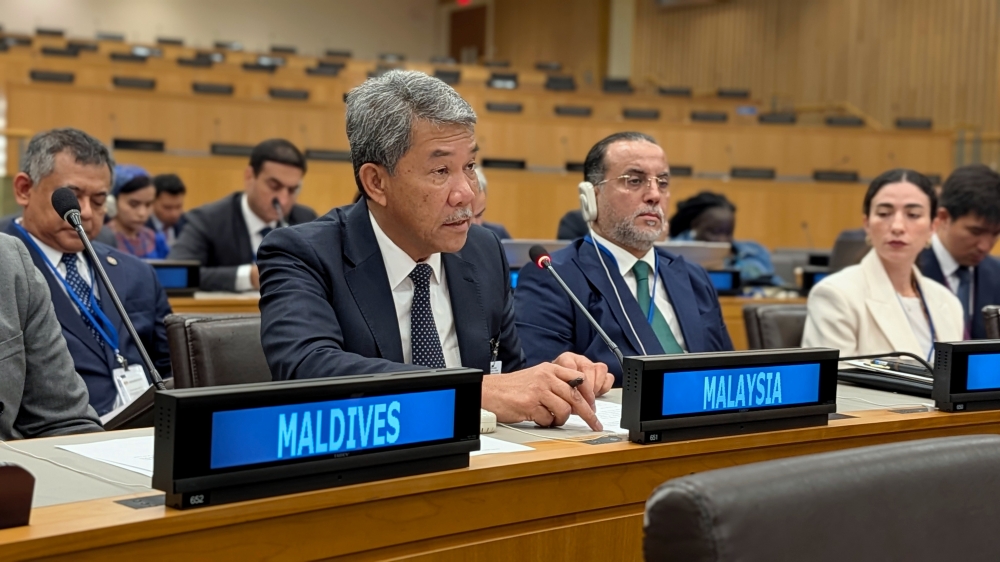
NEW YORK — Speaking at the Ministerial-Level Meeting of the Peacebuilding Commission on the sidelines of the 81st United Nations General Assembly (UNGA) in New York on September 25, 2026, Malaysia’s Foreign Minister Datuk Seri Mohamad Hasan laid out a clear, three-point framework the country believes is essential to building durable global peace.
The intervention, delivered at UN Headquarters, addressed longstanding structural gaps in international peacebuilding efforts — from the need for nationally driven strategies to the critical role of human capital development in post-conflict recovery.
Priority One: Nationally Owned Strategies and Women’s Full Participation in Peacebuilding
Mohamad’s opening priority centred on the principle that sustainable peace cannot be imported — it must be built from within.
“Malaysia supports nationally owned and nationally led prevention and peacebuilding strategies, complemented by preventive diplomacy and mediation efforts,” he said, signalling Kuala Lumpur’s opposition to top-down, externally imposed peace frameworks.
Equally central to this priority was gender inclusion. Mohamad stressed that peacebuilding must ensure the full, equal, and safe participation of women — a position Malaysia has backed not only in rhetoric but in regional policy. The country hosted the 2025 ASEAN Summit on Women, Peace and Security in Kuala Lumpur, an event that produced concrete calls for stronger measures to prevent and address violence against women, and reaffirmed the importance of women’s leadership in peacebuilding processes across the region.
Priority Two: Translating Peacebuilding Commission Work into Coordinated, Development-Linked Action
Malaysia’s second priority directed attention at the operational gap between the Peacebuilding Commission’s mandate and real-world impact on the ground.
Mohamad argued that development and peace are mutually reinforcing forces, not separate policy tracks. “Sustainable development can address the root causes of conflict, while stability enables development to grow and take root,” he said.
To close the coordination gap, Malaysia threw its support behind strengthening ties between the Peacebuilding Commission and the United Nations Economic and Social Council (ECOSOC) — a move intended to better align development, humanitarian, and peacebuilding efforts under a unified international response framework.
“This cooperation is essential to ensure that international support is responsive to national priorities, mutually reinforcing and capable of delivering greater impact on the ground,” Mohamad said, calling for systemic improvements rather than ad hoc interventions.
Priority Three: Building National Capacity and Human Capital as a Foundation for Lasting Peace
The third and final priority shifted focus from international architecture to ground-level capacity — specifically, the human capital and institutional strength that allow societies to sustain peace over time.
Mohamad pointed to Malaysia’s Technical Cooperation Programme as a practical vehicle for this commitment. Through the programme, Malaysia shares its development experience and expertise with developing nations, including those recovering from conflict — making it one of the country’s most direct contributions to the global peacebuilding agenda.
The Foreign Minister also pushed back against the tendency to treat peacebuilding as either a pre-conflict or post-conflict exercise. He was explicit: peacebuilding cannot wait until conflict erupts, nor can it be treated as a phase that ends when fighting stops.
“It was an ongoing process involving efforts to build and sustain peaceful and inclusive societies, resilient communities and stable economies,” he said — framing peacebuilding as a continuous, generational commitment rather than a reactive emergency measure.
Malaysia’s Broader Positioning at UNGA 81
The Peacebuilding Commission address was delivered alongside Malaysia’s participation in the Organisation of Islamic Cooperation (OIC) Annual Coordination Meeting of Foreign Ministers, also held at UN Headquarters on the same day.
Taken together, Malaysia’s engagements at UNGA 81 reflect a consistent diplomatic posture: positioning the country as an active, middle-power contributor to multilateral institutions — one that brings both regional convening power, as demonstrated by the 2025 ASEAN Women, Peace and Security Summit, and South-South development cooperation through established programmes like the Malaysian Technical Cooperation Programme.
The three priorities outlined by Mohamad — nationally led strategies, coordinated development-peace linkages, and human capital investment — align with broader UN reform discussions on making the Peacebuilding Commission more operationally effective and less siloed from the wider UN development system.
About the Author