The ASEAN AI Entertainment Ecosystem is entering a stage where producing content is becoming easier, faster and cheaper. Generative AI can already assist with research, first-draft scripting, subtitles, content variations and parts of the editing workflow. But as production speed improves, a more difficult question is emerging: does the industry actually need more content, or does it need better judgment about what is worth producing?
The bottleneck may be shifting from output volume to quality, review and differentiation.

Faster Production Does Not Automatically Mean Better Content
For creators and MCNs, AI can reduce friction in repetitive production tasks. A single idea can be turned into multiple titles, formats or language versions more quickly than before.This creates obvious advantages, especially for smaller teams.But higher output also introduces a new risk: when everyone can produce more content, the market becomes more crowded. Repetition increases. Generic scripts become easier to generate. Weak ideas can also be scaled faster.
The real competitive question is therefore no longer simply: How much content can a team produce?
It is increasingly: How much useful, distinctive and commercially relevant content can a team produce consistently?
That distinction matters because content volume alone does not guarantee audience attention, creator growth or business value.
AI Makes Human Review More Important, Not Less
As AI enters more parts of the workflow, review becomes more important. A generated script may sound polished but still contain factual errors. A translated caption may be technically correct while missing cultural context. A fast content variation may weaken the creator’s original voice.
For the ASEAN AI Entertainment Ecosystem, this is particularly relevant because Southeast Asia is highly diverse in language, culture and audience behaviour. AI can accelerate production, but humans still need to decide whether the content is accurate, appropriate and worth publishing.This suggests that future creator teams may spend less time producing first drafts and more time reviewing, directing and refining them.
VYBE Is Positioning Around the Creator Workflow
Within this changing production environment, VYBE is positioned as an AI creator platform. Its product direction includes exploring how AI can connect more closely with creator workflows rather than functioning only as a standalone generation tool. The larger opportunity is not simply helping creators produce more material, but making content creation, interaction and decision-making more connected.
That model still requires further validation. The important point is that AI content production becomes more valuable when it is connected to actual creator needs, audience behaviour and commercial objectives.

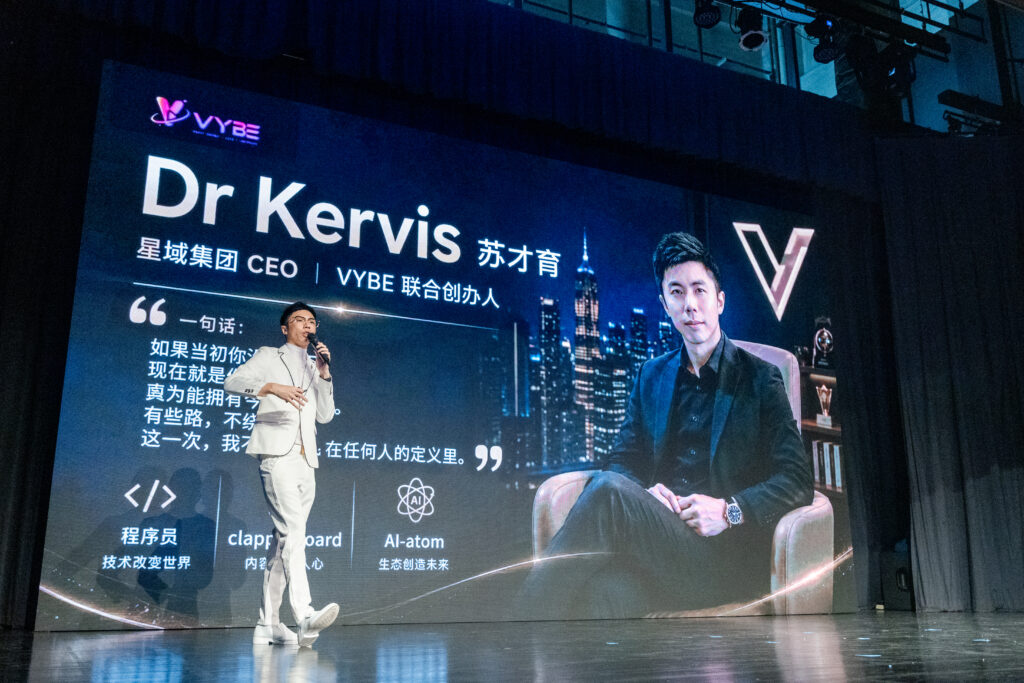
Dr Kervis: Tools Change, but Judgment Still Matters
For Dr Kervis, founder of Xing Yu Group, the AI discussion ultimately returns to human capability.Across his broader observations on entrepreneurship and technological change, four abilities remain especially relevant: judgment, communication, execution and continuous learning.AI can generate options, but people still need to decide which option matters. AI can draft a message, but people still need to communicate with context. AI can accelerate execution, but someone must still take responsibility for the result.
This becomes more important as AI tools become easier to access. When everyone can use similar tools, competitive advantage is less likely to come from the tool itself and more from how well people know what to do with it. That perspective also fits Xing Yu Group’s broader direction around the creator economy: technology may support the system, but sustainable value still depends on how people use it.
The next phase of the ASEAN AI Entertainment Ecosystem may therefore be defined not by who produces the most content, but by who can combine AI speed with stronger judgment, better quality control and clearer creative differentiation.
About the Author