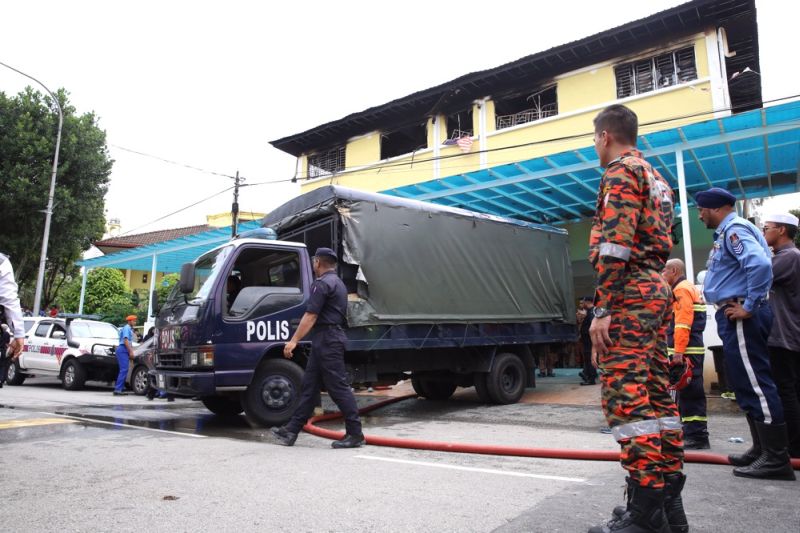
A predawn fire tore through a Kuala Lumpur Islamic boarding school on September 14, 2017, killing 24 people — 22 students and 2 wardens — at a facility that had not obtained the legally required fire safety permit before commencing operations. The disaster at Tahfiz Darul Ittifaqiyah, also reported as Darul Quran Ittifaqiyah, has drawn immediate scrutiny to fire safety compliance failures at religious boarding institutions across Malaysia.
No Fire Permit Obtained: The Tahfiz School Was Already Operating Without Regulatory Clearance
The Fire and Rescue Department confirmed on the day of the tragedy that the school had not secured a fire operating permit before opening its doors to students. Datuk Soiman Jahid, the department’s deputy director-general of operations, stated at the scene that the school had been in the process of applying for a permit at the time of the fire — meaning it was actively operating without one.
“Based on our investigations, the school had not acquired a permit to begin its operations and it was applying for one,” Soiman told reporters, as quoted by The Star.
Under Malaysian local government regulations, premises used for educational or residential purposes are required to obtain fire safety clearance before commencing operations. Had the school complied, Soiman indicated, the department would have conducted inspections and mandated corrective measures — including the installation of hinged, rather than fixed, window grilles.
Fixed Window Grilles Directly Blocked Escape, Investigator Confirms
Physical evidence at the scene pointed to a direct link between the absence of fire safety compliance and the scale of the death toll. The charred remains of all 24 victims were found piled in two corners of a room on the top floor of the building, near the windows — indicating a concentrated, failed attempt to escape through the only visible exit points.
“Based on our initial investigations, the position the victims were found indicated that they tried to escape through the windows but were stopped due to the fixed grilles on the windows,” Soiman stated.
Fixed grilles, as opposed to hinged or openable grilles, are a known fire safety hazard in residential and dormitory settings. Fire safety regulations in Malaysia require that window grilles in occupied premises be of the hinged type, allowing occupants to push them open during emergencies. This requirement is specifically assessed during fire permit inspections — a process the school had not completed.
Eighteen students survived the fire and were receiving treatment at a nearby hospital at the time of reporting.
Cause of Fire Under Investigation, Results Expected Within Days
The precise cause of the blaze remained under active investigation as of September 14, 2017. Soiman identified two preliminary hypotheses: a burning mosquito coil left unattended, or an electrical short circuit.
“We will know more in two to three days. Our men are going through the area to see if we missed any victims,” he said.
Both scenarios — open-flame mosquito coils used in a densely occupied dormitory room, and ageing or unvetted electrical wiring — represent fire risk factors that a pre-operational safety inspection would typically assess and require to be remediated before a fire permit is issued.
The school’s failure to complete this regulatory process meant that none of these risk factors had been formally identified or addressed prior to the tragedy.
24 Dead, 18 Survivors: The Human Cost of a Missing Fire Safety Certificate
The confirmed death toll stood at 24: 22 students and 2 wardens, all found in the same room on the upper floor of the Tahfiz Darul Ittifaqiyah building in Kuala Lumpur. Their physical positions at the time of discovery — clustered near windows barred by fixed grilles — documented a final, unsuccessful attempt to escape a sealed room filling with smoke and fire.
Eighteen other students survived. Their survival underscores that escape was possible where egress was not obstructed — reinforcing the fire department’s assessment that hinged grilles, mandated under fire permit requirements, could have materially reduced the death toll.
The disaster has reignited debate over the adequacy of fire safety oversight for tahfiz schools and other informal religious educational institutions in Malaysia, many of which operate in converted residential or shophouse premises without purpose-built safety infrastructure.
Soiman’s statement — that the incident “could have been avoided” had the school followed local government regulations — represents the department’s clearest indication yet that regulatory non-compliance was a proximate contributing factor to the loss of 24 lives.
About the Author