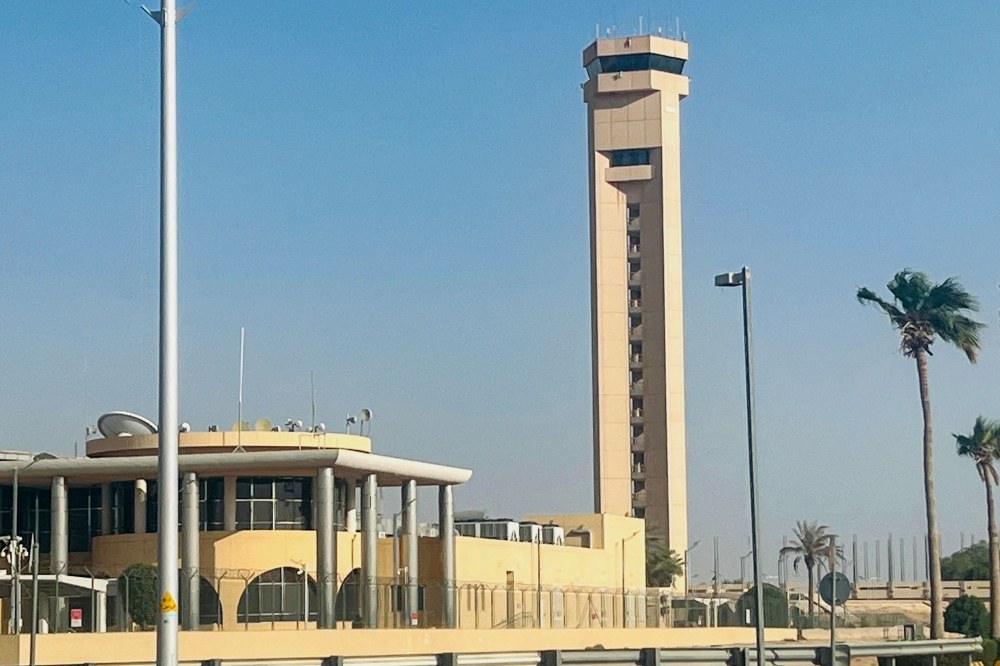
Saudi Arabia’s King Khalid International Airport in Riyadh announced the partial resumption of flights on Sunday, October 25, following a two-week closure caused by Houthi missile and drone strikes — even as Yemen’s Iran-backed Houthi movement immediately warned airlines and travellers that the airport remains a “military target” for their forces.
The development underscores a sharp escalation in the Yemen conflict, one that has rattled regional aviation, energy markets, and Saudi Arabia’s broader economic diversification ambitions.
Houthi Strikes Intensify Across Southern Saudi Arabia as Riyadh Airport Attempts Partial Reopening
Yemen’s Houthi movement launched wide-ranging strikes across large swathes of southern Saudi Arabia on Sunday, the same day the Saudi capital’s international airport declared it would resume flight operations. The Saudi-led military coalition fighting the Iran-backed group confirmed that at least 10 ballistic missiles were intercepted throughout the day.
AFP journalists stationed in Riyadh reported hearing three explosions in the early hours of Sunday morning. Residents received official alert messages warning of a “hostile aerial threat” and instructing them to remain in safe locations. Air defences subsequently intercepted a ballistic missile launched toward the capital, along with two drones in the Riyadh area, according to a coalition statement posted on X.
Attack warnings were also activated across multiple cities in the kingdom’s south, including Khamis Mushait, Abha, Taif, Namas, and Jazan. The coalition later confirmed it intercepted a cruise missile targeting Khamis Mushait.
“The bombardment has been very heavy since this morning — may God keep us safe. Everything is shaking because of the explosions,” one resident in Khamis Mushait told AFP on condition of anonymity.
Houthi Military Spokesman Warns Airlines: King Khalid Airport Remains ‘Unsafe’ and a Designated Strike Target
Houthi military spokesman Yahya Saree issued an explicit warning directed at international, regional, and local carriers — as well as airport staff and passengers — on Sunday, declaring that Riyadh’s King Khalid International Airport remained unsafe and an active military target.
“The Yemeni Armed Forces warn all international, regional and local airlines — as well as staff and travellers — against using King Khalid Airport in Riyadh, as it is unsafe and serves as a military target for our forces,” Saree said in a statement. “The Saudi regime shall bear the consequences of any operations at the airport.”
The warning came just hours after the airport announced the resumption of flights, though the full extent to which operations were actually functional remained unclear at the time of reporting.
The Houthi attacks on the airport have been devastating in their cumulative effect. A strike earlier this month killed 13 people and wounded more than 300, making it the deadliest single attack on Saudi soil in more than a decade.
A Broader Offensive: Houthis Claim Strikes on Three Saudi Airports, Energy Infrastructure, and a Pipeline Within 24 Hours
The Houthi movement claimed that within a 24-hour window, its forces targeted three Saudi airports — including King Khalid International Airport in Riyadh — alongside energy installations, a pipeline, and an air base. The group has also directed fire at oil infrastructure across the kingdom, compounding disruptions to Saudi Arabia’s energy export operations.
The Saudi civil defence agency confirmed it had responded to falling debris in the Mecca and Medina regions on Saturday, following the interception of two Houthi missiles. Riyadh described the incidents as deliberate targeting of the two holiest cities in Islam. The Houthis categorically rejected that characterisation, calling the Saudi claim a “huge lie.”
The Houthi forces also fired at Aden, the southern Yemeni city serving as the interim seat of the Saudi-backed government, stating they had targeted a naval base and military camp overseen by Saudi forces.
Collapse of Yemen Truce and Houthi Red Sea Offensive Drive Regional Instability and Energy Market Disruption
The current escalation follows the breakdown of a years-long truce between the Houthi movement and Yemen’s Riyadh-backed government. The fragile ceasefire had held intermittently since 2022, but collapsed this past summer, reigniting full-scale hostilities.
Last month, Houthi forces completed a lightning offensive that gave the group control of the entire Red Sea coastline of Yemen, a development analysts have identified as a strategic inflection point with significant implications for global shipping lanes and regional security architecture.
The renewed conflict has delivered a material blow to Saudi Arabia’s economic and reputational ambitions. The kingdom, the world’s largest crude oil exporter, has seen businesses disrupted, airlines forced to reroute or suspend services, and residents of multiple cities living under near-daily alert conditions. The strikes have also cast a shadow over Saudi Arabia’s high-profile Vision 2030 initiative, which seeks to reposition the country as a global tourism, investment, and business hub.
Aviation authorities and airlines operating in the region face mounting pressure to assess the risk calculus of continued operations into and out of Riyadh, as the Houthis demonstrate both the capability and stated intent to strike one of the Gulf’s major international airports repeatedly and at scale. — AFP/Additional reporting
About the Author