The evening of July 2, 2026, was dominated by New York headlines about pop superstar Taylor Swift’s wedding at Madison Square Garden. Across Manhattan, however, a 52-year-old Tibetan activist named Lobga Rangzen walked to the plaza outside the United Nations headquarters, planted a Tibetan flag, and set himself on fire. He died approximately one hour later in hospital. The incident — the first Tibetan self-immolation on US soil — drew minimal mainstream American media coverage but sent shockwaves through the global Tibetan exile community of roughly 25,000 people living in the United States alone.
A Decades-Long Pattern of Protest: Rangzen’s Act Follows More Than 170 Self-Immolations Since 2009
Rangzen’s death was not an isolated event but the latest in a documented series of extreme acts of protest by Tibetans against Chinese rule. Between 2009 and 2022, more than 170 monks and laypeople set themselves on fire — primarily inside China, but also in India and Nepal — following a brutal crackdown on mass demonstrations in Tibet in 2008. Beijing, which claims Tibet as an inalienable part of its territory, has maintained and tightened its administrative control over the Tibetan plateau through seven decades of governance.
On the eve of Rangzen’s death, China adopted a new “ethnic unity” law that critics and human rights observers say will further erode the rights of ethnic minorities, including Tibetans. The timing underscored what many in the exile community describe as an accelerating erosion of Tibetan cultural and political identity.
Jigme Ugen, president of the exiled Tibetan National Congress — where Rangzen led the New York and New Jersey chapter — told reporters the act was clearly premeditated. “It wasn’t something he did abruptly,” Ugen said. “He clearly prepared himself.”
Rangzen’s Livestream and Farewell Video Reveal a Calculated, Politically Motivated Decision
Rangzen livestreamed his death. Footage shows a heavily built man crossing a Manhattan street in a traditional Tibetan “chuba” robe, planting a Tibetan flag at the UN perimeter, and being engulfed in flames reaching twice his height. A UN security guard arrived with a fire extinguisher, but too late. New York police confirmed to AFP that an investigation into the death remains ongoing.
Rangzen also released a pre-recorded, six-minute farewell video timed to go public after his death. Speaking in Tibetan while sitting cross-legged — visibly perspiring — he said: “Today, if I engage in alarming activism, it is not because I do not have food, or clothes or out of sadness. I do it for the Tibetan nation.”
His message was explicit: the act was political, not personal. He called on exiled Tibetans to take individual responsibility for the struggle and to help build a new future for Tibet.
A Life Shaped by Family History and Exile: From Lhasa to Queens, via 14 Years as a Monk
Born under the name Lobsang Palden, Rangzen fled Tibet as a young man and spent 14 years as a Buddhist monk in southern India. He arrived in the United States in 2006, eventually settling in Queens, New York, where approximately 25,000 Tibetan-Americans reside nationwide. He later adopted the surname “Rangzen” — the Tibetan word for “independence” — a deliberate declaration of political identity.
His English remained limited throughout his life in New York, and he cycled through various jobs before becoming an Uber driver. Despite financial precarity, those who knew him described his commitment to the Tibetan independence movement as total. Ugen recalled Rangzen saying he was “married to the movement.”
The family history that shaped him was severe. According to both Ugen and Jampa Choedup — a monk and 30-year friend of Rangzen’s — two of Rangzen’s uncles fought with Chushi Gangdruk, an anti-China guerrilla force established with CIA support in 1958. One uncle died in combat; another died in prison after being captured. “He grew up with these stories,” Ugen said.
His niece, Tenzin Choekyi, 21, who lives in Queens, described him as a “joyful” man who regularly joined Tibetan “gorshey” circle dances. She was watching the World Cup on television when a friend contacted her saying her uncle had “burned himself.” She initially assumed a minor accident. The full details, she said, brought “a wave of absolute terror.”
The Dalai Lama, the Government-in-Exile, and the Impossible Bind of Responding to Self-Immolation
Self-immolation as protest places Tibetan religious and political leadership in a position with no clean exit. The Dalai Lama — Tibet’s Nobel Peace Prize-winning spiritual leader, who fled to India in 1959 and has lived in exile ever since — has historically expressed sorrow over self-immolations while questioning their strategic effectiveness. Beijing has accused him of “glorifying” such acts, a charge some scholars have complicated by noting he has also failed to explicitly condemn or attempt to stop the practice.
Following Rangzen’s death, Penpa Tsering, the head of the Tibetan government-in-exile, issued a formal statement urging all Tibetans to “cherish” their lives. “While we honor his devotion, human life is precious and must be preserved to serve the long-term struggle for Tibet,” Tsering said.
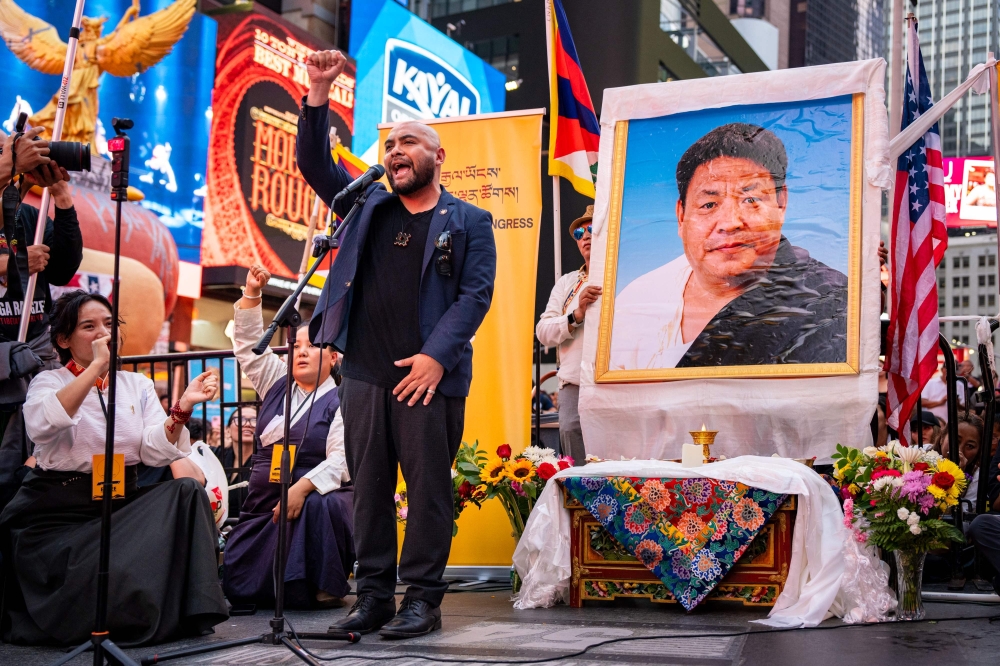
In Times Square on August 1, 2026, a vigil was held for Rangzen, attended by supporters and addressed by New York State Assembly member Steven Raga. Exiled Tibetans erected a makeshift shrine at the UN site of his death, covered in flowers and ceremonial white “khata” scarves. The shrine has functioned as a sustained gathering point for activists.
Choedup, who saw Rangzen the day before he died, said their final conversation centred on Tibetans’ individual duty to pursue freedom. “His passing has left many of us Tibetans with the fervor to act,” Choedup said.
In his farewell video, Rangzen asked those who knew him not to grieve. “There is no need to mourn for me,” he said. — AFP/Malay Mail
About the Author